
How to Prepare Your Dog for Summer Outings
Summer is almost here. And if you're like most dog owners, you already have a mental list of places you want to take your dog.
The patio at your favorite brunch spot. The farmer's market on Saturday morning. The trail you've been waiting all winter to hike. Maybe even just the coffee shop where you always wish you could bring them.
The thing that makes all of those outings actually work isn't an expensive training program or hours of prep work. It's three skills. And you can practice all of them at home, in a few minutes a day, before you ever head out the door.
We put together a Patio Manners video series on YouTube that walks through each one. But here's the overview: what each skill is, why it matters, and how to get started today.
Settle at Your Feet
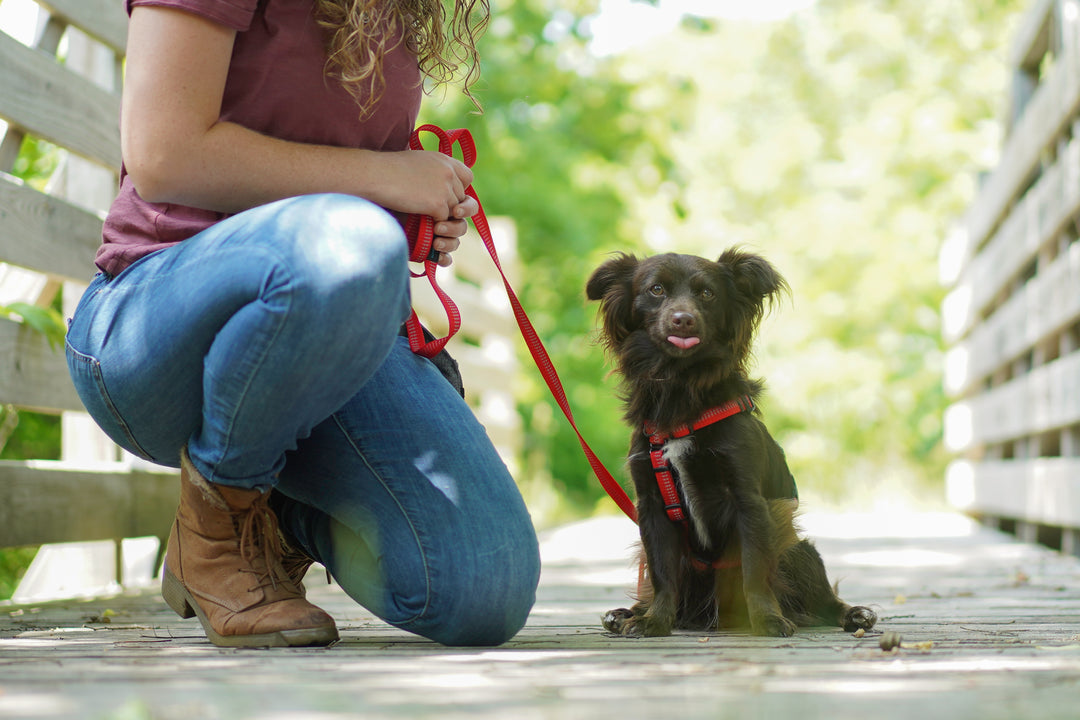
Picture this: you're sitting at a patio table, coffee in hand, and your dog is lying calmly under your legs. People walk by. A plate of food lands at the next table. Your dog notices and then settles right back down.
That's settle at your feet. And it's the skill that determines whether your dog can come to a seated, public space in the first place.
The good news is it's not as hard to teach as it sounds. You just need to build it at home first, somewhere familiar and calm, before you take it somewhere busy.
How to practice it at home:
Sit on your KLIMB or a regular chair; either works great. Hold a treat and use it to guide your dog into a lying down position right underneath your legs. The second they're settled, give them the treat and tell them they're good.
That's the whole thing to start. From there, you build up how long they hold it. A few seconds becomes ten seconds, becomes a minute. Then you start adding little distractions: someone else moving around the room, the TV on, or eating a snack.
The goal is a dog who can stay relaxed at your feet while the world moves around them. Not perfectly still forever, just calm and settled while you sit.
Keep your first practice sessions really short. Two good minutes are better than ten minutes where your dog checks out halfway through. Stop while it's going well, and they'll be more eager to try again.
See it in action: Patio Manners | Train Your Dog to Settle at Your Feet
Leave It
Dropped food near your table. Something questionable on the trail. The moment your dog spots another dog's water bowl and makes a move for it. Leave it is the behavior you'll use more than almost any other when you're out in the world together, and it's one most dogs haven't had enough practice with.
When it breaks down in public, it's usually not because the dog doesn't know the cue. It's because they've only ever practiced it at home, where there isn't much to actually leave. Taking it somewhere with real distractions is a completely different challenge, and it's one worth practicing for.
How to practice it at home:
Put your dog up on the KLIMB or KLIMB Jr. and hold a treat in your closed fist or place one on the floor nearby. Tell them to "leave it" and Wait. The second your dog looks away from the treat and back up at you, say yes and reward them.
You're teaching them that ignoring the thing and checking in with you is what gets them the reward. Once they've got that, gradually make it harder: move the treat closer, use a more tempting item, or longer wait before they get the reward.
Having them on the KLIMB helps here because they have a clear place to be. That makes it easier for them to hold still and focus instead of just circling the treat on the floor.
Before you rely on this skill at a restaurant patio, test it in a more controlled outdoor environment first. On your regular walk place place a low value treat on the sidewalk and tell them to "leave it". This is a low-pressure way to see how solid it really is.
See it in action: Patio Manners | Train Your Dog to Leave It
Polite Greetings
Summer means strangers. A lot of them. At the farmer's market, on the trail, at the outdoor event, where it feels like everyone wants to stop and say hello to your dog.
When your dog can hold a calm sit while someone walks up to greet them, those moments are genuinely fun. Your dog gets petted, the person walks away saying what a good dog, and you feel great about the whole thing.
When they can't hold it, when they're jumping, spinning, or lunging toward every new person, those same moments become something you start to dread. Polite greetings are the skill that flips that.
How to practice it at home:
Start with your dog on the KLIMB or KLIMB Jr. and ask them to sit. Have someone they know, a family member or housemate, walk up calmly and give them attention while they hold the sit. Reward your dog for staying put through the whole thing.
Once that's easy, make it a little harder. Someone they know less well. Someone who comes in faster or with more excitement. Someone new entirely. You're building up to the moment when a stranger at the farmer's market reaches out to pet them and your dog just... sits there. Happily. Calmly. Like it's no big deal.
It will be a big deal. You'll be proud.
The first time you try this outside, pick a quiet spot with low foot traffic rather than a busy area. One easy success in a calm environment is worth more than a tough session somewhere overwhelming.
See it in action: Patio Manners | Train Your Dog to Sit Politely for Petting
Where Do You Start?
If reading through all three of these made your brain a little full, that's completely normal. Pick one. Just one.
Settle at your feet is the one that opens the most doors, so if you're not sure where to begin, start there. Sit on your KLIMB or a chair, grab some treats, and spend five minutes on it today. That's genuinely all it takes to get the ball rolling.
Your dog is more capable than you might think. They just need someone to show them what you're looking for. These three skills are very learnable for almost any dog at almost any age, and building them now means a whole summer of outings that actually go well.
That's worth a few minutes on the KLIMB.
Watch the full Patio Manners series on YouTube: [Blue-9 Patio Manners Playlist link]
Share this