
Simple Fitness Moves You Can Do at Home (No Experience Required)
Here's the truth about canine fitness: you don't have to do it all. You just have to start.
That might look like one exercise while you're waiting for your coffee to brew. It might be a walk where you're paying a little more attention to the terrain you're covering together. It might be as simple as asking your dog to sit and stand a few times before dinner. None of that requires a program, a certification, or a major time commitment. It just requires a little intention and a dog who is always, without fail, ready to hang out with you.
These exercises are rooted in the same principles used by canine fitness professionals and rehab specialists. We've just stripped away the complicated parts so you can focus on what actually matters: moving intentionally with your dog. Research consistently points to rear end strength, core engagement, and body awareness as the foundations of a healthy, mobile dog. Every exercise in this blog builds toward at least one of those things. Pick one or two that feel right for you and your dog and try them this week.
Note: Always consult your veterinarian before starting any new fitness routine with your dog, especially if they are senior, recovering from injury, or have any known health concerns.
Start Here: Beginner Moves
These exercises require nothing more than things you already have access to. No equipment needed.
Get Outside and Explore
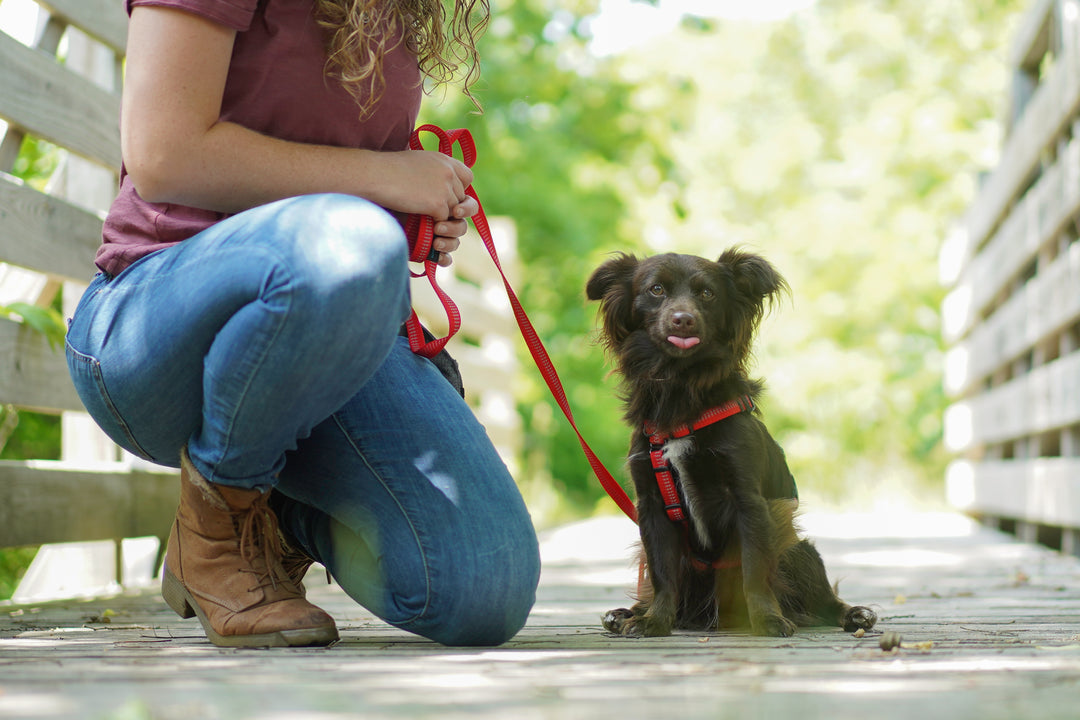
You're already walking your dog. This is just a more intentional version of that.
Next time you head outside, look for opportunities to add purposeful movement into your route. Ask your dog to step up and down off curbs slowly and deliberately rather than hopping over them. Let them walk through a patch of taller grass where their body has to work a little harder with each step. These small moments of varied terrain challenge your dog's muscles and body awareness in ways a flat sidewalk loop simply can't. Dogs naturally carry more of their weight on their front end, and varied terrain helps engage and strengthen the whole body more evenly.
No extra time required. Just a little more intention with the walk you're already on.
Sit to Stand
Ask your dog to sit, then stand, then sit again. Slow and controlled. That's the whole exercise.
This movement, sometimes called puppy push-ups, can target the hindquarters. Dogs naturally carry the more of their weight on their front end, which means their rear end often gets less of a workout than it needs. Sit to stand repetitions directly address that imbalance, building the kind of strength that supports your pup.
Five slow repetitions is plenty to start. You can do this while you're watching TV, waiting for dinner to finish cooking, or any moment your dog is already nearby looking at you hopefully.
Ready for More: Introducing the Propel at Floor Level
Before we get into intermediate moves, here's a beginner friendly way to introduce one of our favorite tools.
The Propel Air Platform is an inflatable fitness platform, think of it as a Bosu ball for dogs. Because it's inflatable it's never completely stable, and that gentle instability is what makes it so effective for building core strength, proprioception, and confidence on unfamiliar surfaces.
The easiest way to introduce it is to place the KLIMB flat on the ground with no legs installed and set the Propel directly beside it. Ask your dog to put their front feet on the KLIMB and their rear feet on the Propel, or vice versa. The KLIMB provides a familiar stable surface while the Propel introduces instability gently. Because there's no elevation involved the only new variable is the feel of the inflatable surface under their back feet. It's a low pressure introduction that builds confidence before the challenge increases, and most dogs take to it more quickly than you'd expect.
One practical note on inflation: less air means more stability and is always the right starting point for a dog new to the Propel. More air creates greater instability as your dog's confidence and strength build. Start low and increase gradually.
Taking It Further: Intermediate Moves
If the beginner moves are starting to feel good, these are your next steps. Same idea, a little more challenge.
The Elevated Stand on the KLIMB
Ask your dog to step up onto the KLIMB with all four paws and hold the position. This is the elevated stand, and it's one of the most foundational moves in canine fitness for good reason. The raised surface shifts weight toward the hindquarters and asks your dog's hindend to engage to maintain their position. It also builds the kind of body awareness that carries over into everything else your dog does, from jumping in and out of the car to navigating uneven terrain on a hike.
The KLIMB's removable legs give you a built-in progression tool. Start with no legs installed for a low approachable surface. Add the short leg accessories to bring it to 6 inches. Install the standard legs for the full 12 inch height. The exercise stays the same. The challenge grows with your dog.
Backwards Walking
Guide your dog to take slow deliberate steps backwards. Five steps is a great starting goal.
This one is deceptively simple and genuinely challenging. Most dogs spend their whole lives moving forward, which means the muscles and coordination required for backwards movement are often underdeveloped. Backing up builds rear end awareness and engages muscles that forward movement simply doesn't reach. It also requires your dog to think carefully about where their body is in space, which is meaningful mental work on top of the physical challenge.
You can practice this in a hallway, a living room, or anywhere you have a little space. Watch your dog's focus sharpen the moment they realize what you're asking. It's one of the more satisfying exercises to teach because the progress is so visible.
Wobble Board Balance
Add the short leg accessories to your KLIMB, install two diagonally, and you have a wobble board. The unstable surface asks your dog's body to work significantly harder just to stay balanced, engaging the core, building proprioception, and developing the kind of stability that reduces injury risk over time. This is also great for boosting confidence as well.
Use Sure Feet Caps, small covers designed to protect the open holes left by removed legs, to keep your dog's paws safe during this exercise. This is one of those moves that looks unassuming from the outside and delivers real results over time.
Elevated Stand on the Propel
If your dog is comfortable at floor level with the Propel, this is a natural and rewarding next step. The fact that you've gotten here at all means your dog has already built real confidence on an unstable surface. That's worth acknowledging.
Ask your dog to place their front feet on the Propel in an elevated stand while their rear feet stay on the ground, or guide their rear feet onto the Propel while their front feet rest on the ground or on the KLIMB. Each variation targets different muscle groups and asks your dog's body to find balance in a slightly different way. Both are excellent. Choose based on what your dog finds most comfortable and build from there.
Just Start With One Thing
Fitness is cumulative. A little done consistently does more for your dog than a lot done once in a while. The dogs who make the most progress aren't the ones whose people do the most in a single session. They're the ones whose people keep showing up, even on busy days, even when it's just one exercise, even when it's just a few minutes while the coffee brews.
Pick one thing from this blog. Try it today. Notice how your dog responds. That's canine fitness, and that's genuinely all it takes to start.
If you want a simple visual reference to keep on your phone, we put together a free April Fitness Inspiration Card with 12 moves to try this month. Save it and come back to it whenever you need a little inspiration. You can find it right here.
Ready to bring these exercises home? We put together bundles that give you everything you need to get started without having to figure out what goes with what. Whether you're just starting out or ready to build a more complete fitness routine, there's a bundle for where you and your dog are right now. Explore your bundle option here, and take the guesswork out of getting started.
Your dog is ready when you are.
Share this