
The Science of a Better Walk: What Research Tells Us About Harness Design and Why Fit Is Everything
Certified professional dog trainer Shoshi Parks has recommended a lot of harnesses over her decade of working with dogs. When Business Insider asked her to review the Blue-9 Balance Harness, her assessment was direct: it "significantly reduces pulling without impeding a dog's movement" and unlike other front-clip options, it "doesn't hang too low and impede a dog's range of motion."
That distinction, a front-clip harness that redirects pulling without restricting movement, is exactly what a growing body of peer-reviewed research tells us to look for. And understanding why it matters is increasingly useful for every professional who recommends gear, sells it, or helps clients choose it.
Here's what the science says.
The Variable That Matters Most: Where the Strap Sits
Researchers across multiple institutions have used tools ranging from pressure-sensing walkways to full 3D motion capture to study how different harness designs affect shoulder extension, stride length, weight distribution, and joint angles during movement. Across all of it, one variable emerges most consistently: where the chest strap sits relative to the shoulder joint.
When a chest strap crosses the body at or below the scapula, it directly interferes with shoulder extension on every stride. The consequences over time are significant. Dr. Christine Zink, DVM, PhD, one of the foremost authorities in canine sports medicine and rehabilitation, has been clear on this point: "Harnesses that limit shoulder extension and restrict forelimb excursion could predispose dogs to shoulder tendinopathies." The supraspinatus and biceps tendons, the structures most directly affected by restricted shoulder extension, are among the most common sources of chronic forelimb lameness in active dogs.
When the chest strap sits above the shoulder blade instead, in a true Y-shaped configuration, it keeps the point of contact away from the joint entirely. Zink describes the mechanism precisely: the Y-harness places the majority of its pressure "on the manubrium, which is a very stable bone that supports the entire dog's body." The load lands where the body is built to carry it, not where it disrupts movement.
Lafuente, Provis & Schmalz (Veterinary Record, 2019) confirmed this in peer-reviewed research, finding that strap placement was the primary driver of shoulder restriction across both restrictive and non-restrictive harness designs, measurable at both walk and trot. The category label matters less than the actual position of the strap on that individual dog.
What the Research Adds
The Lafuente study opened a door that subsequent research has continued to walk through. Pálya, Rácz, Nagymáté & Kiss (PLoS ONE, 2022) used full 3D motion capture to measure 18 joint angles and 35 movement parameters across multiple harness types, finding that no single harness was universally superior, and that fit on the individual dog was the determining variable. Williams, Hunton, Boyd & Carter (Journal of Applied Animal Welfare Science, 2023) studied 66 dogs across multiple breeds and found meaningful differences in how each dog responded to the same harness based on individual conformation. Their recommendation: treat every dog as an individual when selecting and fitting a harness, with specific consideration for conformation, age, and musculoskeletal history.
The most recent contribution, Dowdeswell & Churchill (Reinvention, 2024), tested six harness designs on 30 dogs using high-speed video analysis and reinforced the same throughline. Harnesses whose straps crossed or sat near the shoulder joint showed the most significant impact on movement. Design execution is what separates a harness that performs from one that doesn't.
Taken together, these studies don't argue against harnesses. They define precisely what a well-designed, well-fitted harness needs to do: keep contact above the shoulder joint, fit the individual dog's conformation, and stay functional across the range of body types that walk through your door.
About Front-Clip Harnesses Specifically
A front-clip harness works well when one condition is met: the chest strap sits above the shoulder joint so it can redirect without restricting. When that condition is true, a front-clip harness does exactly what it's designed to do: redirect pulling through body mechanics without compromising the dog's natural gait.
The research confirms what happens when that condition isn't met. Front-clip designs whose straps hang too low cross the shoulder joint on every stride, interfering with the very extension that Zink identifies as essential to long-term shoulder health. The finding isn't that front-clip harnesses are inherently problematic. It's that strap placement is what determines whether a front-clip harness supports the dog or works against it.
That's a solvable design problem, and it's exactly what the Balance Harness was built to solve.
How the Balance Harness Is Built Around These Principles
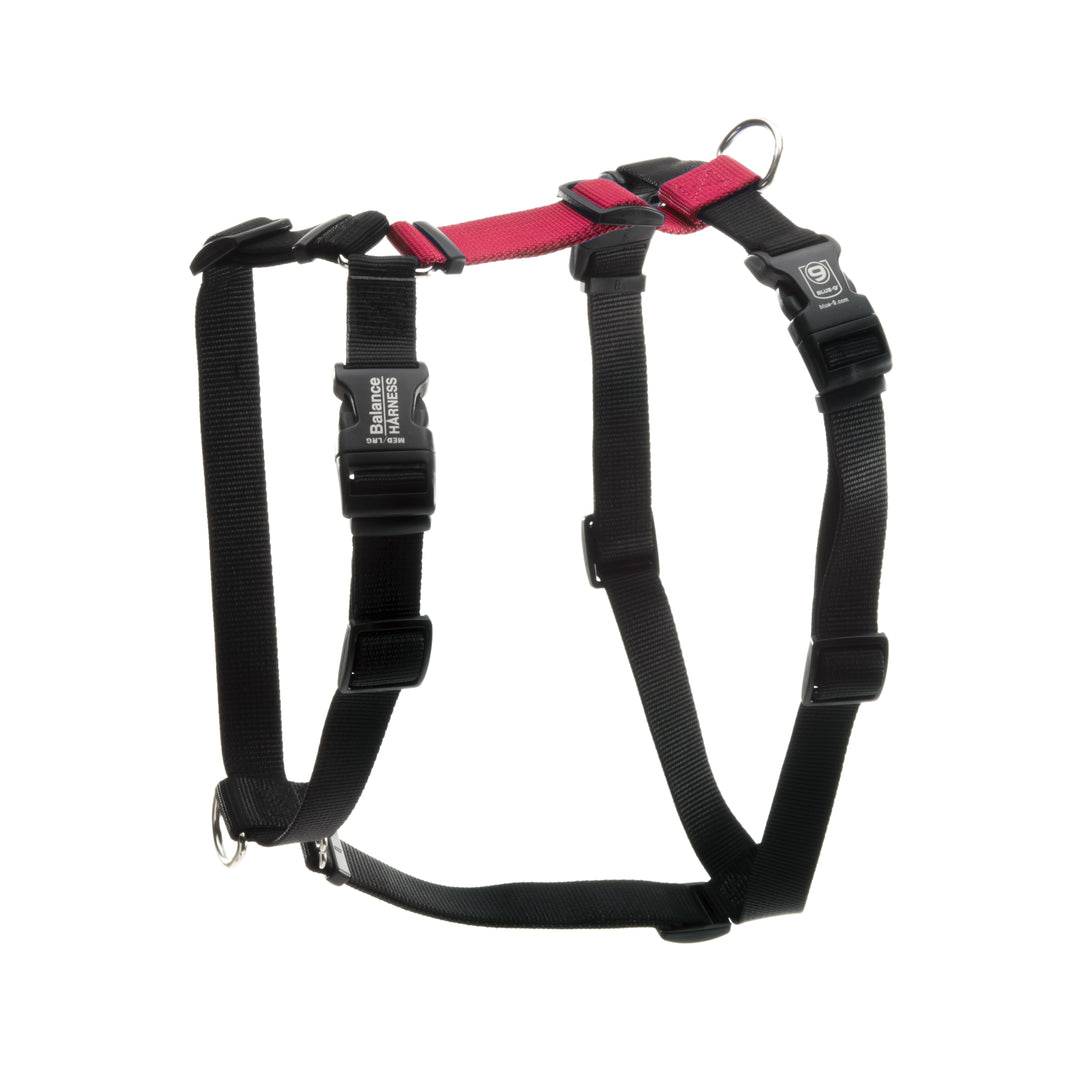
The Blue-9 Balance Harness is a front and back clip harness designed with each of these principles built directly into its construction.
The Y-neck design positions the chest contact point above the shoulder joint rather than across it, keeping pressure on the manubrium where Zink identifies the body is equipped to receive it, and away from the supraspinatus and biceps tendons that poorly positioned harnesses load on every stride. This is the single most important design feature the research identifies, and the feature that most standard front-clip harnesses get wrong.
Six points of adjustment make it possible to achieve the precise fit the science identifies as essential, across dogs of varying body types, chest depths, and neck widths. A reviewer at The Dogington Post described the result: the Y-neck design "fits your dog like a necklace and doesn't rub over their shoulders, giving them full range of motion without restriction." Hardware placement keeps contact points away from the armpits and spine, and the adjustability is broad enough to accommodate the individual variation that the Williams study tells us to expect across breeds and conformations.
The front D-ring redirects pulling effectively because the strap is positioned where it can redirect without interfering with the shoulder joint. The attachment is designed to move naturally with the dog's stride, allowing full, fluid movement while still redirecting forward momentum when the dog pulls. A back D-ring provides a second attachment option for dogs that don't pull, for training contexts where a double-ended leash connects both rings simultaneously, or as a dog progresses through training and needs less front-clip guidance. The harness adapts to where the dog is in its training in a way most harnesses can't offer.
Why This Matters for Your Practice and Your Clients
The research gives professionals something genuinely useful: a way to explain gear quality in terms that go beyond brand preference or personal experience.
When you can tell a client that strap placement affects shoulder extension on every stride, that chronic restriction of the supraspinatus and biceps tendons is a documented pathway to forelimb lameness, and that their dog's individual conformation is the starting point for any harness assessment, you're not selling a product. You're educating a client. Clients who understand the why behind a recommendation follow through on it, come back, and refer others.
For retail buyers and specialty retailers, the same logic applies. The harness category is crowded with products that look similar on a hanger. What distinguishes the Balance Harness is that every design choice is defensible, the fit system is genuinely functional across a wide range of conformations, and the outcomes are consistent enough that professional trainers reach for it by name. That's a product with a story that's easy to tell, and now there's science to help tell it.
Sources
- Zink MC. To Harness or Not to Harness? That Is the Question. Avidog International, 2019. Originally published Whole Dog Journal, May 2013.
- Lafuente MP, Provis L, Schmalz EA. Effects of restrictive and non-restrictive harnesses on shoulder extension in dogs at walk and trot. Veterinary Record. 2019;184(2):64.
- Pálya Z, Rácz K, Nagymáté G, Kiss RM. Development of a detailed canine gait analysis method for evaluating harnesses: A pilot study. PLoS ONE. 2022;17(3):e0264299.
- Williams EL, Hunton V, Boyd J, Carter A. Effect of harness design on the biomechanics of domestic dogs (Canis lupus familiaris). Journal of Applied Animal Welfare Science. 2023. doi:10.1080/10888705.2023.2259796
- Dowdeswell L, Churchill L. The influence of harness design on forelimb biomechanics in pet dogs. Reinvention: An International Journal of Undergraduate Research. 2024;17(S1).
- Carr BJ, Dresse K, Zink MC. The effects of five commercially available harnesses on canine gait. Proceedings, American College of Veterinary Surgeons Surgical Summit, 2016.
- Parks S. Blue-9 Balance Harness review: A professional dog trainer recommends this harness. Business Insider. October 2024.
Share this